The Specificity/Universality of Sinead O’Connor
To the extent that casual music fans (which is to say, most people) know her, it’s as a “one-hit wonder” whose best known song was a cover. It happened to be written by the legendary artist Prince, whose own songwriter demo of “Nothing Compares 2 U” didn’t get released from his vaults until after his untimely death, largely because her performance of it made it hers.
Sinead O’Connor was a hell of a songwriter in her own right, and a screaming banshee and pure force of nature on record and stage (I never got to see her live, alas).
The songs she wrote, including her best one, “The Emperor’s New Clothes,” were brilliant, but so idiosyncratically about her that they’ve been deathly-intimidating for another artist to cover. In that stream-of-consciousness diatribe, addressed to an un-named “you,” a poison pen letter without a standard verse-chorus-verse structure, but with a refrain that alternates between “If I treated you mean / I really didn’t mean to” and “Maybe I was mean / But I really don’t think so,” she pulls the listener in with (hardly universal!) stanzas like
But you know how it isAnd how a pregnancy can change youI see plenty of clothes that I likeBut I won’t go anywhere nice for a whileAll I want to do is just sit hereAnd write it all down and rest for a while
and just makes you feel it, like it was your life. It is, ironically, Dylan-esque. There was a period in the late 60’s when Dylan addressed a lot of his songs to an unnamed “you.” They were also poison-pen letters: “Positively 4th Street” and “She’s Your Lover Now.” She nearly stole one of his genres! Her reward, in case you’re too young to remember, was getting booed off the stage of Madison Square Garden at a Dylan tribute concert a few weeks after she tore up Pope JP2’s picture on SNL because he covered up the Church’s child sexual abuse scandal. (Dylan fans who can afford expensive concert tickets have always been more about vibes than lyrics or intellectual interpretation.)
If blogs existed in 1992, Sinead O’Connor would have been vindicated in a matter of weeks instead of the decades it still will take for people to realize that she was a truth teller and that the corporate media once again covered up for a bunch of pedophiles.
Besides “Nothing Compares 2 u,” O’Connor always had a great instinct for other people’s songs. Her cover of Nirvana’s “All Apologies” was haunting, elegiac. It helped me process Kurt Cobain’s suicide, and that record, Universal Mother, seems to be at hand for many deejays who are trying to process her death.
O’Connor took a long break from putting out records in the 00’s. Her comeback record, 2012’s brilliant How About I Be Me and You Be You, made its centerpiece another cover song. John Grant’s “Queen of Denmark” is, like Sinead O’Connor’s best-written songs, so specific that it would seem to defy being covered. It’s clearly about a simmering break-up between two gay men. A stanza like
I wanted to change the worldBut I could not even change my underwearAnd when the shit got really, really out of handI had it all the way up to my hairlineWhich keeps receding like my self-confidence
is eventually followed by
I hope you know that all I want from you is sexTo be with someone who looks smashing in athletic wearAnd if your haircut isn’t right you’ll be dismissedYou get your walking papers and you can leave now
The specificity of the anger is what makes the song somehow so universal. After the record, Sinead O’Connor apparently made the song a hallmark of her concerts; sometimes performing it as the opener, sometimes as a set-ending climax and sometimes as an encore. But, always, letting out her banshee wail for the chorus:
Why don’t you take it out on somebody else?Why don’t you bore the shit out of somebody else?Why don’t you tell somebody else that they’re selfish?A weekling, coward, a pathetic fraud?
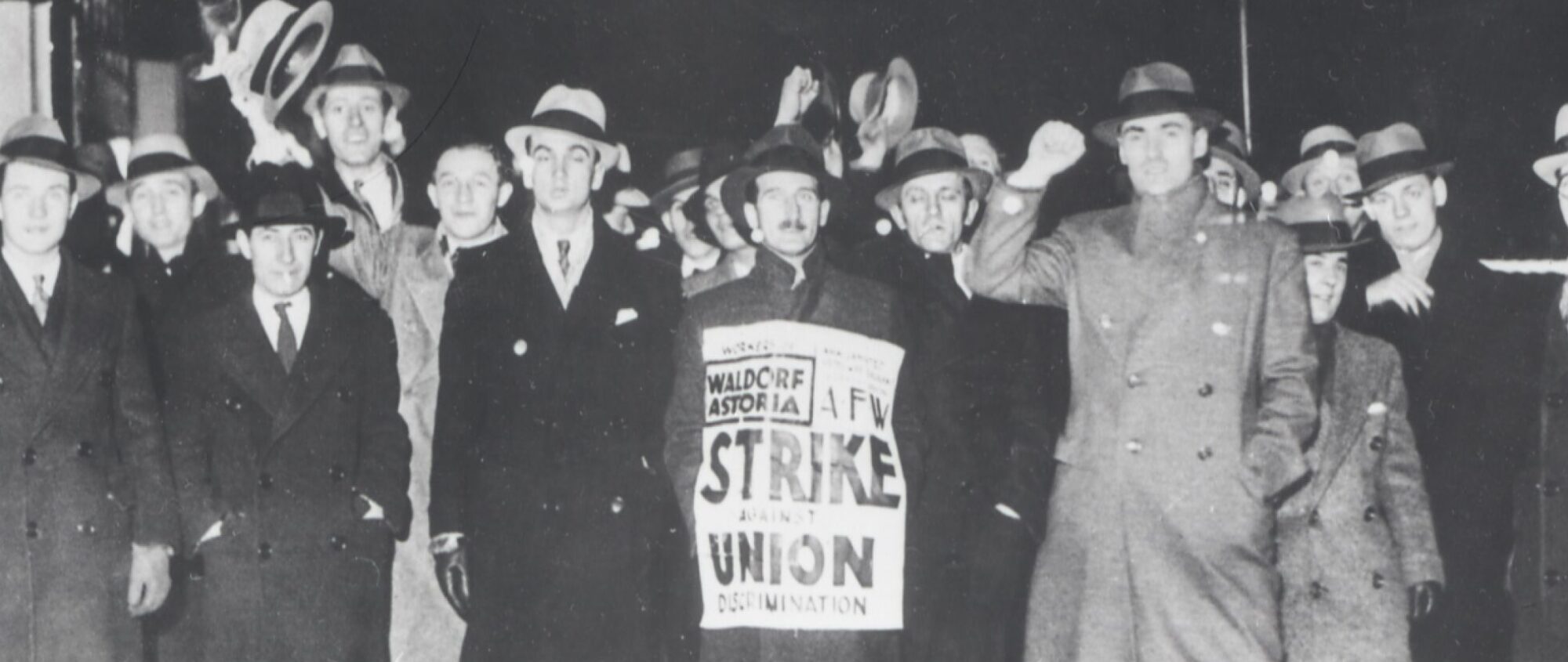
When Labor Fought Rock-and-Roll
Facing the world ain’t easy when there isn’t anything going
Standing at the corner waiting watching time go by
Will I go to work today or shall I bide my time
So begins the Kinks’ song, “Get Back in Line,” one of the most hauntingly beautiful paeans to the forced idleness and stress of unemployment ever committed to tape.
I’ve turned to this song for solace, a little too often for comfort, but I’ve always been discomfited by the refrain that follows.
‘Cos when I see that union man walking down the street
He’s the man who decides if I live or I die, if I starve, or I eat
Then he walks up to me and the sun begins to shine
Then he walks right past and I know that I’ve got to get back in the line
Is this just Ray Davies being a contradictory crank? He has, after all, written songs snarking about health prescriptions from government doctors (“National Health”) and complained “I was born in a welfare state / Ruled by bureaucracy” about his childhood experience of getting moved from an inner-city still pockmarked with unexploded Nazi bombs to a planned satellite garden community.
According to Davies, the song was inspired by a period in the late 1960s when the Kinks were prevented from performing in the United States, which he vaguely blamed on the musicians’ unions. The Kinks missed the summers of love and Woodstock, remaining behind in the United Kingdom. Due in part to that isolation, the Kinks are celebrated as perhaps the most quintessentially British of the British Invasion bands, one that put out songs about Queen Victoria and “little shops, china cups, and virginity” while everyone else was doing the whole “sex, drugs and rock-and-roll” thing.
But did the musicians’ union really “ban” the Kinks from America? If so, how were they ever so powerful? And what, if anything can modern labor advocates learn from this curious history?
The answer can be found in Tell Tchaikovsky the News: Rock and the Roll, the Labor Question, and the Musicians’ Union, 1942–1968, a recent book by Michael James Roberts about how the American Federation of Musicians (AFM) fought rock-and-roll as an emerging art form — and in the process, lost much of its power.
Roll Over, Beethoven
It’s almost impossible to imagine that a union of musicians could ever exercise monopoly power in an industry as complex as entertainment, but the AFM did so from the 1930s into the 1950s. One reason is that the industry was significantly less complicated; there were only a handful of major record labels, a few radio networks, and a finite number of concert halls. As a traditional craft union, the AFM trained and certified “qualified” musicians and forced the employers to get their musicians from the union’s hiring hall. Part of the strategy of a craft union is to try to restrict the number of workers to roughly the amount of available work.
So rock-and-roll was legitimately a threat to the union’s power, as it flooded the market with non-traditional musicians, and the cottage industry of independent labels and unconventional concert spaces that sprung up around the devil’s music undercut the union’s bargaining power.
The union’s own hostile reaction to rock-and-roll exasperated the problem.
Start with the AFM’s structural problem of not making room for rock musicians in the membership. As a craft union, the AFM needed to vouch for the professionalism of its members, who could, theoretically, get hired out to any union shop. One baseline standard of musical professionalism is the ability to read sheet music. Rock musicians, by and large, don’t. They learn by ear, playing along to records or just mucking about with tunings and electrical feedback in the garage.
To induct a rock musician who couldn’t pass the reading test would open the union’s hiring hall up to the risk of sending, say, Jerry Lee Lewis to sub in a Broadway orchestra and having the conductor send him back with the complaint, “This bum can’t play!” That might sound ridiculous now, but it was a significant structural barrier to the AFM keeping up with the times.
The format of high-fidelity records was itself a threat to the union’s power. In the context of radio stations filling their airwaves with pre-recorded classical music and big band swing rather than hiring multiple live bands every day, they are a job-killing technology.
In 1943, the union waged an impressive industry-wide strike to force the record companies to pay mechanical royalties to musicians who appear on records. But the union still wanted to limit the use of records on the air, and waged various campaigns to keep live music on the air.
But rock-and-roll is essentially a recorded art form. The records
that get put out into the world, whether on vinyl or MP3, become the definitive versions of the songs for fans, their happy accidents of studio noise, feedback, and weird pronunciation to be noted and obsessed over. The rapidly growing audience for popular music would accept no substitute for their favorite songs on the air.
Because the record industry was also slow to recognize the market for rock music, a lot of the early singles were produced by new upstart record labels like Chess, Philles, Stax, and Motown. Since the AFM refused to grant membership to many of the artists on those labels, the union missed the opportunity to organize them (despite the fact that those artists were, and still are, getting screwed out of their fair share of royalties). Today, most records are produced by non-union record labels that may nevertheless be distributed by the majors.
When rock music was recorded at unionized labels, the union’s collective bargaining framework treated rock bands more like employers than actual workers. The hiring-hall model assumed a producer or a big band leader assembling a full band of professional musicians. But a rock band can combine bandleader, songwriter, singer, producer, and the core musicians into one collective unit. Their need for the hiring hall was for extra musicians — a horn section or some strings — whom they are responsible for paying the union scale.
Rock music’s impact on the hiring hall is documented in the excellent 2008 film The Wrecking Crew, about the loose group of in-demand studio musicians who helped create a lot of famous songs in the 1960s. They were union members who stood out from the hiring hall crowd for their ability to transcend and collaboratively transform the music written on the page.
In order to specially request a musician, a band would have to also pay for the one whose number came up on the day’s roll. The film treats the idled musicians as objects of derision, sitting in the lobby in their navy blazers reading the newspaper while Carol Kaye is in the studio punching up the bass line to Sonny & Cher’s “The Beat Goes On.”
Union deals that call for workers to get paid for not working are notoriously hard to defend. Meanwhile, to this day, more rock stars turn up in the AFM’s database of employers than on their membership rolls.
Still, the story of the union isn’t solely about its role in preventing the emergence of new, innovative music. As many obituaries of the late great Chuck Berry noted, sometime in the 1970s he stopped touring with his own band. What’s less commented upon is that his contract rider spelled out that concert promoters had to hire a bassist, drummer, and piano player from the local AFM hiring hall. After all, how else could he be sure that they could really play (and that he wouldn’t have to bother negotiating a wage scale)?
We Love You Beatles, Oh Yes We Do
During the first wave of rock-and-roll, the musicians’ union mostly focused on professionally ostracizing the new breed of performing artists, and promoting cultural education for teenagers about the merits of classical and jazz music and the virtues of live performance. They also encouraged congressional investigations into the “payola scandal,” the elaborate web of schemes the upstart labels improvised to bribe radio deejays into giving their discs extra spins on the air (as if there was anything new or unique about corporations trying to buy their way to cultural dominance).
Payola and the variously coincidental airplane crashes, arrests, and military conscriptions of its biggest stars seemed to have put an end to the “fad” by the dawn of the 1960s. When rock music roared back to life with a British echo in the mid-1960s, the AFM gained a new more powerful tool with which to fight it: our nation’s immigration laws.
In order to work in the United States, British Invasion bands had to apply for H visas that required affidavits — subject to challenge — that there were no qualified American workers available to do the job.
“We can go to Yonkers or Tennessee and pick up four kids who can do this kind of stuff,” the AFM unsuccessfully argued to block the Beatles from reentry.
It’s true that to this day Paul McCartney can’t read sheet music, but the AFM’s legal argument was obviously a willful misreading of what “kind of stuff” the Beatles actually did.
While the union doubled down of their definition of professionalism and cultural merit, they sparked one hell of a backlash from teenage Beatlemaniacs. One emblematic letter from a San Diego teenager to the Secretary of Labor goes:
Please sir, what is the exact story on this? How will you determine whether there are qualified Americans when the Beatles request readmission? If you ask me or any other teen-age girl (and there’s a lot of us) there is no one who comes close to their talent, and we mean it!
Roberts includes a number of archival letters like these in Tell Tchaikovsky the News. As delightful as they are to read with 20/20 hindsight, they also point, Roberts argues, to the drift of labor from the Left.
The teenage girls and boys (of which there were many) who could not fathom a social movement that would try to restrict the free cultural exchange of the music they loved had a similarly difficult time understanding why the AFL-CIO was one of the staunchest organizational supporters of the war in Vietnam. By the time union building-trades workers were beating the shit out of hippie antiwar protesters in the “hard hat riot” of 1970, the cleavage was doomed to last for at least another generation.
In the end, the Beatles were a widely beloved cultural and capitalist force that the AFM was simply no match for. John Lennon may have sang, “The way things are going, they’re gonna crucify me,” but ultimately it was the Kinks that had to climb on that cross.
The key difference seems to be the Davies brothers’ penchant for onstage fisticuffs and their general surliness. The AFM managed to block the band from entering the United States from 1965 until 1969, essentially by arguing that they were dangerous aliens and that there were thousands of American workers who could do exactly what Ray and Dave Davies could do.
Only a schlocky Hollywood villain would try to prevent kids from listening to rock-and-roll, but in retrospect, that’s exactly the position that the American Federation of Musicians found themselves in.
In the labor movement, many organizers tend to assume that the way unions are organized and bargain makes sense because someone smarter than us evaluated all the options and decided on our present course as the best possible one. “It is what it is,” we shrug and tell ourselves. But maybe we should be asking something more along the lines of, “Are we trying to kill rock-and-roll?”
Also a Worker
On Super Bowl Sunday, Jacobin posted a simple tweet, “Lady Gaga: also a worker” (in response to a previous tweet noting that Tom Brady was a worker, though one badly in need of some basic political education). The account was promptly showered with dozens of negative and hostile responses from joyless and doctrinally confused leftists.
Granted, Gaga is rich and famous — a peculiar digital-age version of what Vladimir Lenin called the “labor aristocracy” — but she is a worker. Her art is the product of labor — hers and others’ — and I guarantee you that nobody involved in making her music and videos is receiving a fair share of the revenue that they generate for giant corporations.
As a result of the musicians’ union’s inability to adapt to the changes in the record industry, songwriters, bandleaders, rock stars, and pop icons like Gaga are not able to bargain collectively — a loss of power that reverberates down the chain of production.
The most notable collective action taken by recording stars in recent memory was an effort to create a streaming service to rival the bottom-feeding Spotify and Pandora, essentially asking fans to pay more for their music — not for the corporations to take less of a profit. And the most notable sustained effort by recording artists to gain more control over their working conditions, the Future of Music Coalition, is a 501(c)3, not a union.
One fantasizes about Beyoncé, Jay Z, and Daft Punk announcing instead that they were becoming charter members of a new AFM local dedicated to figuring out how pop stars could strike and boycott media conglomerates to wrest more control over what they’re paid, what they pay for, and who has final approval of their art.
Absent that, the American Federation of Musicians’ clearest pathway back to power might — irony of ironies — be through live music. Their defense of live music on Broadway, where they have members and contracts under attack, is one that generates a good amount of public sympathy. Who wants to pay a hundred dollars or more for a ticket to a “live” show and listen to canned music?
Meanwhile, recording artists who aren’t stratospherically famous make most of their money on tour. Notably, the number of concert venues in major cities is again becoming rather finite and increasingly owned and managed by chain employers like Bowery Presents. That’s the kind of concentration of ownership that can give a well-organized union real power under our current labor relations framework.
Rebuilding that power won’t look like the union’s 1943 strike, and it certainly shouldn’t look anything like the union’s approach to the dawn of rock-and-roll. But it also won’t happen by surrendering to forgone conclusions about how unions should be structured, conduct their bargaining strategy, or conduct their protests.
[Originally published at Jacobin.]
“I’ll miss you when you’re gone away forever.”
The Pre-Posthumous Recordings of The Artist

I’ll be the millionth writer to note that 2016 has been absolute murder on legendary musicians so far. And now Prince is gone.
I don’t have a full obit, a critical reappraisal or anything terribly profound to add; just a few musings on record shopping that are too long for a Facebook status update.
Many artists of Prince’s stature and longevity usually leave behind a trove of posthumous recordings, so that they remain platinum-selling artists years after their death. And, of course, now their holograms can go on tour in support of those new records (the future is a strange place). But Prince was a legendarily prodigious recording artist. It’s not an unusual year that sees Prince out out two or three new records! (or, rather, saw; the past tense doesn’t feel right yet). And, so, Prince is the rare artist who has dozens of pre-posthumous recordings ready for purchase. So, before you bemoan the fact that you will never hear a new Prince song ever again, there are hundreds – perhaps thousands – of hours of Prince music that is new to you, waiting to be picked up and taken for a spin.
When I got married, I heard my record collection through new ear’s: my wife’s. Kate sort of played DJ with my records when we first moved in together, and put in heavy rotation some discs that I might have only spun once every other year previously. Prince was one of those. Embarrassingly, I only had The Very Best of Prince, when everyone knows that greatest hits are for housewives and little girls. So, out of a renewed appreciation, and a desire for a little more variety, I started picking up more Prince CD’s every time I visited a used record store.

I never really bought new Prince records. His stuff was much more of a used record store hunt for me. And there’s a ton of them in every used record store. Music going digital caused a lot of fans to tell their copies of Purple Rain and 1999 (of which there are millions!) to make some room and a buck. But I was also able to score the one-and-done discards of fans who actually bought the new records to sort through whether it was a good one, a great one or a mediocre one. Emancipation, Musicology, 3121 – that whole blur of records that he put out after regaining his name and artistic freedom just in time to watch the music industry basically collapse.
And so, the only profundity that I will leave you with is this: go out and buy 3121. It’s the best recent Prince record that I’ve heard and you probably have not. It feels classic and new and like listening to an old friend all at once. Plus, he interrupts one slow jam with a falsetto command to “Turn off your cellphone,” which, if nothing else, would make a great ringtone.