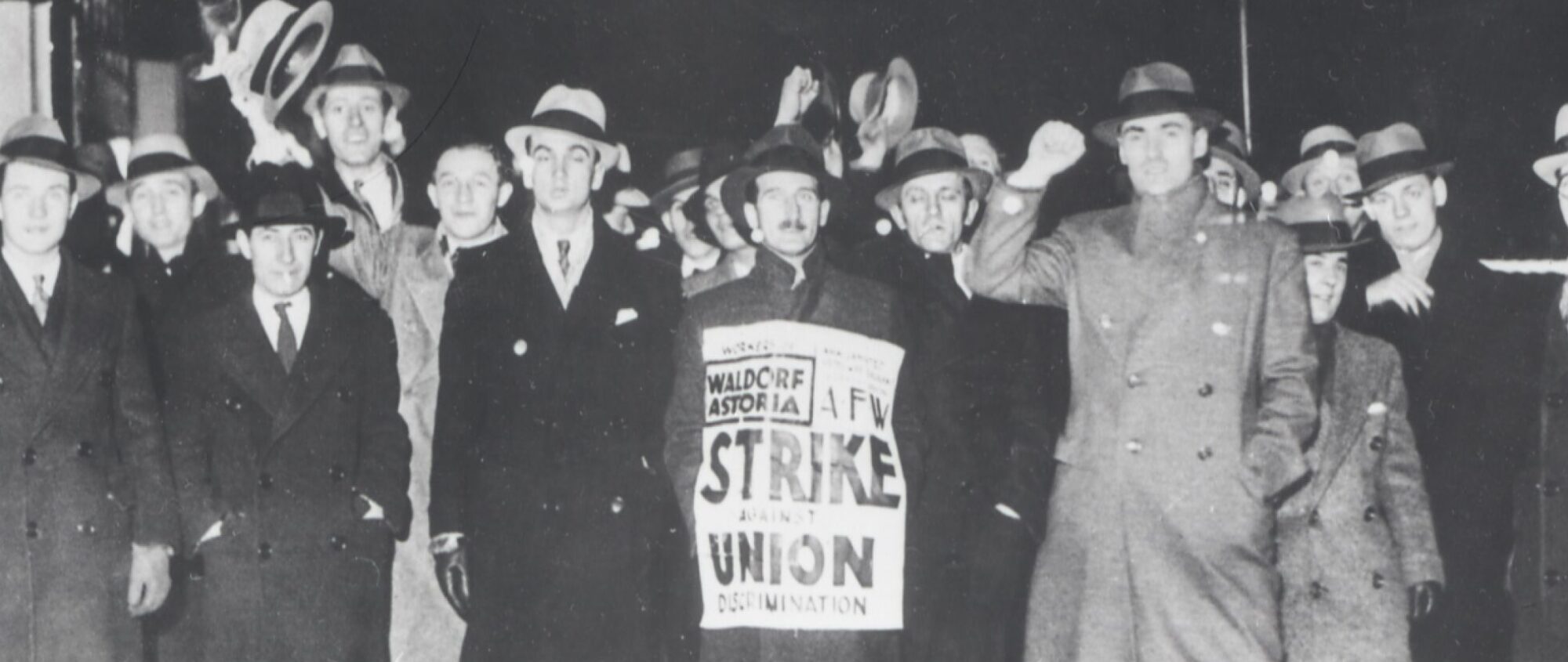
Archive for May, 2005

Bigger, Faster, Harder: Organize My Teeming Masses, Baby!

Monday, May 30th, 2005

The New York Times has published yet another of its series of articles encapsulating developments in the power struggle within the labor federation. It’s hard to express how disappointed I am in how this debate has degenerated. What started out as an exciting difference of opinion on the way forward for organizing masses of new union members, taking on Corporate America and winning huge gains for working families has wound up being just another acrimonious electoral campaign.

First, there’s John Sweeney, who, as a public speaker may be as electrifying as dirt, but is nevertheless responsible for a minor renaissance that saved “Big Labor” from a premature death in the mid-1990′s, and who would have been looked back upon fondly by historians for sparking the resurgence in labor’s fortunes that we all hope is just around the corner. Though he promised to serve just ten years when first elected in 1995 and even once attempted to amend the AFL-CIO’s constitution to mandate the retirement of officers who have reached 70 years of age, Sweeney, at 71, is actively dismantling his legacy in order to serve one more term (the history of such power struggles suggests that he should have rode off into the sunset and handed the reins to his #2, the widely-liked Richard Trumka). The Organizing Institute will be greatly scaled back. The Union Summer program (one of the only youth-focused union programs) will be scrapped altogether. And 30% of the AFL-CIO’s staff will be “downsized” in a mean-spirited effort to placate the opposition.

The opposition, meanwhile, has backed off their most radical plans for forcing mergers and jurisdiction consolidation. Their newest proposal basically calls for the Federation to do what the Sweeney administration did, but faster and harder, while shrinking its budget by diverting more money to the international unions whose intransigence and selfish agendas have undercut the goals of Sweeney, et. al.

My crude “faster, harder” double entendre is apt since, at the “Future of Labor Conference” at Queens College last Fall, SEIU Exec. VP Gerry Hudson boldly posited that “bigger is better” when it comes to union structure.

Harvard professor Elaine Barnard’s snarky rebuttal that “it’s not the size of the boat, but the motion in the ocean” should be even more appreciated now. While the various union presidents have beaten each other bloody over issues of personality and structure, an opportunity has been lost to wrestle with the labor movement’s strategy and message. Should we engage in large scale campaigns against major corporations to organize low-paid workers? Should we break with the Democratic party? Should we commit resources to the south or focus on improving laws in the northeast? Strengthen and improve international alliances and third-world coalitions?

Or should we replace a bunch of old white guys with a different bunch of not-quite-as-old guys and just keep doing what we’ve been doing, except faster, harder and with less dissent?

Goodbye, Jamaica Avenue

Saturday, May 28th, 2005

One of my favorite eccentricities of the neighborhood in which I grew up is about to be eradicated in order to “alleviate confusion.” In actual fact, it’s to alleviate racist fears.

I grew up in a neighborhood called Floral Park, which is situated in outer-most Queens – so far east, in fact, that the neighborhood is bisected by New York City’s border with Nassau county. Right on red? Well, if you’re on 258th Street, you’re in the clear, but if you’re on 259th, you’re risking a ticket, unless you’re north of 89th Avenue. Best of all, our southernmost border in Northeastern Queens is called Jamaica Avenue – except when it’s called Jericho Turnpike.

Built in 1809 by the Brooklyn, Jamaica and Flatbush Turnpike Company, Jamaica Avenue is one of the oldest and most central arteries on the island we call Long. In Brooklyn, it’s Empire Blvd before it becomes E. New York Ave. Throughout Queens, it’s always been Jamaica Ave., and in Nassau it becomes Jericho Tpke.

All of these transitions are seamless, except for the two-mile stretch where the avenue serves as the border between the city and suburbia, and is called Jamaica Avenue on one side, and Jericho Turnpike on the other. A few years ago, the business community in Bellerose, one of three neighborhoods split by the road, formed an association to promote business on both sides of the border. The association made an immediate goal of eradicating Jamaica Avenue. The effort was defeated at the time as a clear effort to whitewash the neighborhood. Jamaica is a predominantly black neighborhood in central Queens, Jericho is a name associated with the lily-white suburbs, but both names have equal standing along the two-mile stretch of border. Is the Bellerose business community interested in naming both sides “Jamaica?” Hell, no!

Unfortunately, it now seems that the City Council has given in and will rename the northern side of Jamaica Avenue, Jericho Turnpike. Score one more for a failed society that refuses to build affordable housing and votes down school budgets in the interest of keeping taxes low. Score one more against racial equality and social integration.

Yo, Brooklyn!

Thursday, May 26th, 2005

I’m sure you’ve all been waiting patiently for my 2005 election cycle endorsements. The sad fact is there is not much to be excited about in the upcoming NYC elections. Freddy Ferrer has squandered much of his goodwill from the 2001 elections, and the Democratic contenders are likely to savage each other in the primary and hand Bloomberg an easy re-election. And, sadly, there doesn’t seem to be a strong independent candidacy to support.

The outlook is considerably brighter in Brooklyn, where community activist Gloria Mattera is running for Borough President. Gloria is a community activist with deep support in Park Slope, where she received 30% of the vote in a City Council election in 2001. She has been a very strong anti-war voice, and, as the Chairperson of the NYS Green Party, she has helped ensure that the party extend its message beyond environmentalism to become a true progressive champion of responsible development, community control, peace and justice and economic rights.

She is the only credible candidate in the Brooklyn Borough President race, where the incumbent, Marty Markowitz, clowns around as “Brooklyn’s biggest cheerleader,” and the Republicans probably don’t have enough support to field a candidate. Gloria’s campaign will be the highest profile campaign for an independent progressive during this election cycle, and deserves support from good people around the city.

A letter from Gloria Mattera:


Dear Friends and Supporters,

Some of you may already know that I have decided to run for Brooklyn Borough President. I need your help to make this important campaign a success.

There is something serious happening in Brooklyn that we cannot ignore. The current BP, Marty Markowitz, has allowed billionaire developer Bruce Ratner to change the character of our borough for the sake of getting himself a “hometown” basketball team.

The proposed Ratner development includes 17 skyscrapers, with most over 50 stories with a token of low income housing thrown in. Even if all the housing were affordable instead of high-end, the secondary displacement effect would destroy the diversity and culture of Fort Greene, Prospects Heights, Bed-Sty and more. This is not the only scandal attached to the Markowitz-Ratner deal.

Ratner is using eminent domain to take away the homes of those living in the footprint of the development. He has bought off and gag ordered area residents. So far, the power has been removed from the City Council for the project to be reviewed by through the Uniform Land Use Review Process. Taxpayer subsidies are over one billion and climbing. This project must be stopped!

No democrat has stepped up to challenge Markowitz on his crusade of overdevelopment throughout Brooklyn so it is up to us – Green Party members and social justice activists.

The campaign is committed to raising the 50,000 dollars necessary to receive matching funds from the Campaign Finance Program. Although I raised close to 15,000 dollars for City Council and received over 50,000 in matching funds, this effort will require more. Please give as generously as you can. Print out the attached donor card and send that with your contribution made payable to: Committee to Elect Gloria Mattera 2005, 437 2 Street #1 Brooklyn, NY 11215.

Your time and involvement in the campaign is also important. Please send me an e-mail or fill out the volunteer form at www.electgloria.org to sign up for petitioning, tabling and outreach.

The campaign will also focus on other important issues – so stay tuned for more updates. I look forward to your participation.

peace & struggle,

Gloria 718 369-2998

Si Gerson

Wednesday, May 25th, 2005

Si Gerson, the last vital link to the Communist Party’s glory days in NYC politics in the 1930′s and 40′s, died last December at the age of 95. Si was a valued colleague and comrade, and I miss him. The CP will be hosting a memorial in Si’s honor on June 10th.

Si was a journalist and political activist during the Popular Front era, when the CP enjoyed considerable mainstream clout as a partner in the American Labor Party, a New York coalition party consisting of labor activists, Socialists, Communists reform Democrats and liberal Republicans that effectively took back the city from Tammany Hall for a time.

Bookended by a corruption scandal that forced Mayor Jimmy Walker to flee the city in 1932 and by the start of anti-Communist hysteria in 1947, the era saw New York City freed from the grip of Tammany Hall hacks through political and electoral reform. The ancient Board of Alderman was replaced by a more representative City Council that would be elected by proportional representation (a ranked ballot that allowed the voter to express support for his favored candidates that could be redistributed to less favored candidates until one has won a majority vote). The CP’s Popular Front tactic was to run its candidates in its own name, but to support strong ALP and independent Black candidates where they existed.

Si demonstrated a knack for campaign strategy and legalities, and managed the repeated campaigns of Peter V. Cacchione, a popular community activist in Brooklyn, who, in his second campaign, became New York’s first Communist Councilman. Years later, Si wrote the political biography, “Pete.” The book is a fine legacy, and I strongly recommend it to scholars of NYC and leftist history for Si’s evocative day-to-day detailing of the campaigns and strategies, the vote counts and the convoluted workings of borough-based single transferrable voting – not mention fun memories of Young Communist League and Young People’s Socialist League members holding demonstrations in support of racial integration in the Ebbets Field bleachers, decades before the Dodgers finally hired Jackie Robinson.

Si Gerson was the focus of two major controversies during this period. First, as a cub reporter for the “Daily Worker,” Gerson was hired by Manhattan’s new progressive Borough President to be his executive assistant. The city’s papers (most notably, “The Daily News”) howled, and called on Stanley Isaacs to fire the young Communist. Isaacs brushed aside the criticism by insisting that Gerson was the best man for the job, and the controversy died. Gerson remained in the position for three years.

Gerson fared far worse when controversy reared its ugly head in 1947, as the Communist Party became Public Enemy #1 in the U.S.A. Proportional representation came under attack in New York since it had enabled not just Peter Cacchione but also Ben Davis, Communist from Harlem, to be elected to the City Council. A city charter revision was put on the ballot to revert elections to district-based winner-take-all contests. Cacchione campaigned with all his strength against the measure, but it passed and Pete’s heart literally broke. He died of a heart attack with one year left to his term.

Under the rules at the time, the vacancy on the City Council was to be filled with a member of the same party, nominated by the authorized party committee and ratified by the Council itself. Naturally, the members of the Communist Party selected Cacchione’s trusted partner, Si Gerson, to fill out the remainder of the term. The City Council balked at electing a Communist at a time when membership in the Communist Party was being outlawed. They delayed and allowed Pete’s term to expire.

Si Gerson was later arrested under the Smith Act, although by that time the law had been set aside and he served no prison time (Ben Davis, the Communist Councilman from Harlem, died in prison after his Smith Act conviction).

Si continued to write for the “Daily Worker,” becoming its Executive Editor, as it morphed into the “Daily World,” and, later, the “People’s Weekly World.” When the CP began running presidential tickets again in 1976, Si was the natural choice to serve as campaign manager. He remained the party’s resident election expert, although campaigns became fewer and farther between as the party increasingly supported the Democratic ticket following Jesse Jackson’s 1988 campaign for President.

Navigating the byzantine election requirements (the laws regulating ballot access across the country became much more draconian during the Red Scare) convinced Si that third parties had to unite in order to pry open the political process. He was a figure in just such a formation, the Coalition for Free and Open Elections, which is where I met and worked with Si, who served as the organization’s secretary until failing health forced him to step back and I succeeded him. In the mid-90′s, younger, successful third parties like the Greens and Libertarians came to dominate CoFOE and pushed for a narrow focus on knocking down signature requirements for ballot access. Si remained steadfast: free and open elections means not just lower petition requirements, but universal suffrage, campaign finance, proportional representation and a guarantee that all votes be counted. He felt vindicated by the recent election board monkey business in Florida, Ohio and elsewhere. Si, and his comrades, had been complaining about the lack of essential fairness in elections for years. Now the country was noticing what Si had been focused on for years.

Si’s Memorial will be from 6:00 pm until 8:00 pm on Friday, June 10 at NYU’s Tamiment Library (70 Washington Square South).

Civil Rights for the Mentally Ill

Tuesday, May 24th, 2005

From my comrade in Staten Island, Tom Good:

Dear Comrades,

Please sign the online petition for civil rights for the mentally ill at – http://www.petitiononline.com/just1nyc/

** Please list your organization if you are in a union or healthcare related employment – or are a member of a mainstream political action group as we are trying to pressure elected officials to do the right thing. **

If you are free tomorrow evening:

Community Board One will hold it’s meeting tomorrow evening at 7 PM at
the Saint George Theatre – located at 25 Hyatt Street, Staten Island.

The CB meeting is devoted to a discussion of the proposed Saint Vincent
Catholic Medical Center’s Fort Place supported housing project for 50 very stable psychiatric patients. SVCMC Behavioral Health CEO Dr. Brian Fitzsimmons and Residential Services Director Marianne DiTommaso have been invited to speak for the hospital. Opponents of this project have been spreading fear among residents of the St. George community and will be coming out in force to oppose the project. It is critical that we have a large group of supporters present at the St. George Theatre to counter the large group that is expected to be there in opposition.

Other healthcare providers from Staten Island, including Project Hospitality and the National Alliance for the Mentally Ill will be sending groups of consumers, staff, etc. to the meeting. We need to turn out as many progressives as possible. Bring large posters that state, in big letters, “WE SUPPORT HOUSING FOR PERSONS WITH MENTAL ILLNESS”, or “FAIR HOUSING FOR ALL”, or anything on that order! It is important that we have people arrive early so we can get seats in the theatre.

For folks coming from the Ferry:
Walk up the Borough Hall stairs across from the Ferry Terminal, go up the steep hill that is Hyatt Street and the theatre is on the right just before the traffic light.

For more information, call Tom at 718.818.5528 or 347.524.5631

The Wal-Mart Revolution is Bananas!!!

Monday, May 23rd, 2005

There’s a pretty good article in today’s Washington Post about legal efforts to block Wal-Mart from invading the region. These include a measure that would restrict the location of stores larger than 120,000 feet (the typical size of a Wal-Mart Supercenter) and one which would require employers to spend eight percent of their payroll on health care if they have more than 10,000 employees in Maryland (only one company employs as many people while paying far less than eight percent on health care; guess which one?).

Efforts like these, and our own Wal-Mart Free NYC, are having their effect. Wal-Mart’s stock price has been stagnant for years. Sure, they’re a huge corporation making billions of dollars in business, but Wall Street always wants more. Wal-Mart’s failure to expand into America’s large urban areas is hurting them, slowly but surely.

But, oh, how can we consumers resist all that cheap underwear? From the Post:

The results can be seen at the cash register. At the Wal-Mart supercenter in Spotsylvania County, which opened in March, a basket of 23 popular household products, including such brands as Jif peanut butter, Maxwell House coffee and Reynolds Wrap aluminum foil, cost $60.37. At the nearby Giant, less than a mile away, the same 23 products cost $75.55, or about 25 percent more.

Grover and Linda Wilson, both self-employed, drive 25 miles to the Spotsylvania supercenter from their home in Rhoadsville, Va., passing both Giant and Safeway on the way. The Wilsons don’t mind that Wal-Mart workers have no union.

“You can’t pay people $20 an hour and sell bananas for 33 cents a pound,” Grover Wilson, 62, said.

What’s funny about old Grover’s “observation” (not sure where he got that $20 an hour figure; the local union contract calls for $13 an hour in wages – even with healthcare and pension factored in, the pay is still not that high) is that it echos the complaints of socialists in the former East Germany. In the months following the fall of the Berlin Wall, as the political focus shifted from greater democracy and openness towards the West to welcoming international capitalism and dismantling the welfare state, German socialists would commonly complain, “We didn’t fight this revolution for bananas!”

But the Wal-Mart revolution is bananas. It’s about cheap underwear and $60 teevees. We’re not supposed to be worried about the social costs of all that crap – the sweatshops in China, the welfare payments that subsidize the company’s low pay, the discrimination against women and so on. We’re just supposed to be grateful that prices are falling almost as fast as our wages.

From the End of Your Leash

Thursday, May 19th, 2005

I finally reached one of my goals for this website and got my first batch of free CDs for review, thanks to the good people at Bloodshot Records. Don’t think any less of my journalistic integrity if I wind up only writing positive reviews. I’ve long been a fan of the record label and its stable of clever and nervy alt.country artists.

Perhaps the best record that I missed in 2004, “From the End of Your Leash” features the outsized sounds and ambitions of Bobby Bare Jr.’s Young Criminals’ Starvation League. A smart-ass songwriter in the finest Nashville tradition (his pop has dozens of Top 40 country hits to his credit), Bare Jr. is not afraid to let his masterful arrangements – complete with Stax horns and lovely harmony from Carey Kotsionis – compete with his frequently witty lyrics.

“Hey, brother, could I borrow your girlfriend?” he asks in the album’s opening line. “I promise not to ask her to stay.” Elsewhere, he tips his hat to his hometown, where “You don’t even have to sing on key / Producers with computers can fix it all in Nashville, Tennessee,” and plays at puppy love on the title track: “I look cute at the end of your leash / Your adorable beast / As I salivate on your shoes.”

I had the pleasure of seeing him live at Bloodshot’s BBQ at the Union Pool in Willamsburg, during the last CMJ. With his shock of curly hair and large rockstar sunglasses, he cuts a figure not unlike a young Bob Dylan. His warm personality, good humor and unique voice (the prettiest steel-wool-on-chalkboard you’ve ever heard) easily distracted the audience from free hot dogs and Rheingold for 50 minutes.

Bobby Bare Jr. will return to NYC on June 9, when he opens for alt.country’s ultimate smart-asses, the Old 97′s, at Irving Plaza. That’ll be the hot ticket for smart new music.

The good folks at Bloodshot also provided me with an advance copy of the newest Waco Brothers’ disc, “Freedom and Weep,” due out in August. It’s a much more straight-ahead rock-n-roll sound than their last disc, and it’s something to look forward to.

A Brief Return to the Twentieth Century: Gang of Four at Irving Plaza

Wednesday, May 18th, 2005

The Gang of Four returned to New York in great style and form last night, showing no signs of their two-decade gap in performing. They were tight and sharp and ready to take over the world. Darting across stage and frequently switching places, Andy Gill’s jagged guitars sounded every bit as dangerous as they do on those old records while Jon King punctuated his singing by wildly flailing his arms like some sort of spastic messiah.

It felt a bit like a socialist church (the crazy, speaking-in-tongues, big-tent revival kind) as the crowd (a wonderful mix of old-timers and kids) screamed along with lines like “The change will do you good!” and “To Hell with poverty!!!”

The set list was mostly restricted to songs from their first two albums, the only ones that all four original members played on, although the late, Joseph Conrad-quoting “We Live As We Dream, Alone” was a welcome surprise. I understand the band will be re-recording some of their old classics for release on iTunes and perhaps some sort of modified petroleum product (they don’t own their original masters, so this would be the way to make a proper profit for their trouble). This is not unwelcome, but new material would be well worth the wait. This is one reunion that only serves to enhance the band’s legacy.

Brooklyn’s own Radio 4 is opening for the entire national tour. They’re a great band, but their sound is awfully, ah, inspired by Gang of Four, and I feared that they wouldn’t compare well side-by-side, but they acquitted themselves nicely.

Baseball and Hardball

Tuesday, May 17th, 2005

I saw my first Mets game of the season, a terrific 9 to 2 bludgeoning of the Reds. “Value” tickets for last night’s game were just $5 for the nosebleed seats in the upper decks. For $5, one can’t really complain. Actually, I rather prefer it way up there. All the games that I saw as a kid were in the upper decks, so that’s how I learned to follow the ball in play. Those box seats behind home plate are just a little overwhelming.

The Mets have a pretty good team this year. They actually win as often as they lose. All I ask is for a little excitement and suspense.

The next two nights are also “value” days, and tickets will be the same price. Tickets will obviously be much more expensive when the Yankees visit this weekend. “Value” days return on May 31 when the Mets face the Diamondbacks. I recommend organizing group outings for a nice day at the ballpark.

This is a rushed post because I am heading out the door to do some more leafletting at the Staten Island ferry. It’s on the Manhattan side this time, as it is all Tuesdays in May, from 4:00pm until 6:00pm. And, once again, leafletting on Thursdays is on the Staten Island side from 4:00pm until 6:00pm.

Finally, on Wednesday, the Writers Guild will be stepping up their public campaign against CBS, outside of Carnegie Hall, where the network is unveiling its new shows for the Fall, from 2:30 until 4:30.

From my friend Marija Kowalski:


Dear Union Brothers and Sisters,

We are in a tough contract battle with CBS/ Viacom for 430 employees at CBS News. The affected employees are news and promotion writers, editors, graphic artists, desk and production assistants, and researchers. The company is trying to take many jobs out of the union. This would impact many members who’ve been in the union for decades. The company also wants substantial paycuts (up to 21%), to have automatic elimination of our contract in the case of any mergers, and allow managers to do unlimited amounts of work historically covered by our contract, to practically eliminate seniority protection from layoff, and many other outrageous attacks on our union.

As you know, Viacom is one of the five largest media conglomerates in the nation. We are counting on the support of our fellow union brothers and sisters to help us defend our contract against this giant corporation.

We have two events coming up– one tomorrow, and one next week. We realize it is a lot to ask. We would be very appreciative if even one person from your union came to the action tomorrow (an email about that event was sent out last week) and a larger group of people would come to the rally outside the Shareholder meeting. I would also love to hear from you to get an idea of the turnout. I would also appreciate if you would distribute this email to your lists.

Thank you very much!!


Taking On Viacom: WGAE at Viacom Stockholders Meeting Thursday, May 26 / 1:30 p.m.

Join the WGAE on Thursday, May 26th as we tell Viacom that we will not sit quietly as CBS demands pay cuts from writers in order to line the pockets of its top three executives with over 150 million dollars.

All owners of Viacom A and Viacom B stock are entitled to attend and participate in their Annual Stockholders meeting. The Writers Guild of America, East will be there too, inside and outside, demanding that CBS withdraw its regressive demands for pay cuts and the removal of union jobs, and instead start working with us to negotiate a fair contract.

Marriott Marquis
Broadway @ 45th Street
New York City

We are delighted to announce the New York City Labor Chorus will be performing at this rally.
We hope you will join us!


Working Harder for Les: WGAE Rally Out Front at the Upfront
Wednesday, May 18 / 2:30 – 4:30 p.m.

WGAE Rally Outside Carnegie Hall!

This year, CBS shocked the industry by giving unprecedented compensation packages to its top three executives.

Meanwhile, CBS is demanding WGAE news and promo writers, graphic artists, desk and production assistants and researchers take paycuts of up to 21% and lose union jobs.

Les Moonves must be stopped. It’s time we receive recognition for our award-winning work.

For more information, contact Marija Kowalski at mkowalski@wgaeast.org

Carnegie Hall
57th Street & 7th Avenue
New York City

Marija Kowalski
Organizing Coordinator
Writers Guild of America, East
212-767-7808

Terrific Coverage from Staten Island’s Paper of Record

Saturday, May 14th, 2005

Union members distribute fliers protesting plans for 2 local Wal-Marts

By ROB HART
STATEN ISLAND ADVANCE
Friday, May 13, 2005

A Queens resident who helped derail Wal-Mart’s attempt to build a store in his borough joined union members and volunteers yesterday in protesting the big-boxer’s plans to build on Staten Island.

Shaun Richman, along with members of Local 342 of the United Food and Commercial Workers Union, handed out small orange fliers to late-afternoon commuters at the St. George Ferry Terminal

“[Wal-Mart comes] in and all the small shops close down,” contended Richman. “They’re welfare cheats and they produce jobs that don’t pay
enough.”

The retail behemoth is eyeing industrial tracts in Mariners Harbor and Richmond Valley. Either would be the first Wal-Mart in New York
City.

Besides the alleged detriment to small businesses, the fliers accused Wal-Mart of poor labor practices in regard to health care, discrimination against women and the disabled, and tax evasion.

“I don’t think it’s a good thing for Staten Island,” said Michael Santorella of Port Richmond, who was clutching a flier while waiting for the next boat. “They don’t seem to do the right thing, and I don’t think I would shop there.”

Martha Rohman of West Brighton agreed: “This company has a history of discriminating against its workers, especially women. I would be much happier if they never built it, and I’m glad there are people out here talking about how bad an idea it is.”

Ravenswood

Friday, May 13th, 2005

I was very excited to receive in the mail this week all of the books and syllabi for my first courses at the U-Mass Labor Studies program. I’m taking Labor Law, with Harris Freeman, and Labor Research, with Tom Juravich. I decided to start lightly with “Ravenswood: The Steelworkers’ Victory and the Revival of American Labor,” which Juravich co-wrote with Kate Bronfenbrenner, and which is included in the syllabus for the Labor Research course mostly, I assume, to add color to the discussion.

Ravenswood was an early 90′s lock-out at an aluminum processing plant of which I had never previously heard. Juravich and Bronfenbrenner argue that this little-remembered labor struggle presaged the revitalization of the labor movement experienced later in the decade, and represented the first time that American unions successfully combined a labor action with a corporate campaign, boycotts and international solidarity; a recipe for what they differentiate from mere corporate campaigns as a “strategic campaign.”

Located in West Virginia, the Ravenswood plant had been a part of the Kaiser Aluminum corporation until leveraged buy-outs, asset spin-offs, restructuring and other corporate shell games in the 1980′s produced an independent Ravenswood Aluminum Corporation, seemingly owned by a former plant manager with a chip on his shoulder and a clear agenda of union-busting. The new owners combined jobs, forced overtime and cut back on safety regulation, resulting in several deaths inside the plant. When the contract came up for renewal, management proposed austerity cuts and stalled the negotiations, while spending millions on new security and scab recruitment. When the contract expired, management rejected the union’s offer to continue working under the terms of the old contract pending a new agreement, and instead locked out 1700 union workers.

The workers at USWA Local 5668 held strong, but it was several months before the Steelworkers’ international union got directly involved in the campaign, which ultimately lasted two years. International Vice President George Becker personally took over the campaign and directed his legal staff salvage the local’s paper-thin and sure-to-be-rejected unfair labor practice charges with the NLRB.

Juravich and Bronfenbrenner narrate the book as an interesting chronological story that anyone could enjoy, but any union staffer reading the early chapters is keeping mental score of all of management’s ULPs – including surveillance and retaliation for union activity, refusal to bargain over health and safety (a mandatory subject of bargaining), general surface bargaining, unilateral implementation of a final offer and an illegal lock-out – knowing that management’s goof-ups mean that the workers have a right to get their jobs back with massive back-pay!

USWA’s intervention in 5668′s ULP case is presented as a bit of great luck, when, in fact, the question should be asked, “Where the heck were they earlier?” Fifteen years later, any union that’s serious about winning has a sophisticated program of cataloguing grievances and management activities in order to identify multiple violations of federal labor law that will protect and enhance the union’s own activities.

Elsewhere, the USWA is more inventive in pressing the campaign of the workers’ lock-out. They create an “end-users” campaign that focuses on the beverage companies who utilize aluminum cans from the Ravenwood plant and, carefully skirting the ban on secondary boycotts, pick away at Ravenswood’s significant customers, one by one. They press health and safety issues at the plant with OSHA. They join environmental coalitions in highlighting the plant’s pollution.

The Steelworkers also press a corporate campaign against Marc Rich, the billionaire investor, on the lam from the U.S. for tax evasion and illegal arms sales to Iran, who, through shadow entities is the true owner of Ravenswood. With much assistance from the international federations (global umbrella groups of international unions – mostly European and North American – that are slowly becoming labor’s answer to the trans-national corporation) engage in demonstrations and lobbying that bring unfavorable press to Rich at his Swiss hideout and sink several lucrative financial deals.

Ultimately, the pressure works. Rich ousts the management team at Ravenswood. All of the locked-out workers get their jobs back. Pay and pensions increase. The plant remains open.

George Becker goes on to become President of the USWA. Richard Trumka, who directed his union’s (the Mineworkers) support becomes Secretary-Treasurer of the AFL-CIO. Many of the tactics used at Ravenswood have become ubiquitous in the labor movement. They’re not always successful, but a strategic campaign, focused on leverage and soft spots, combined with a united workforce is more often successful than not.

Of course, then again, management has gotten a lot more sophisticated in the last fifteen years and rookie mistakes as the initial Ravenswood management team made are fewer and farther between.

Gimme Free

Wednesday, May 11th, 2005

Free shows are for the unemployed. This fact used to piss me off…when I had a job. Two years ago, I remember leaving work early and racing all the way downtown to see one of my favorite bands, Spoon, play a free show at Castle Clinton, only to be among the hundreds of fans who were beaten to the punch by the reserve army of the unemployed. I finally made up for that day by seeing Spoon play a terrific free show at the Virgin record store yesterday.

Spoon are, to my mind, the band of the decade. They are exactly the sort of band that rock geeks long for: a tight little band, a sympathetic voice, a distinctive sound, a little mystery and lyrics that you sing along to before you even know what they are. I first read about the band in Camden Joy’s review of their record company kiss-off single. It was the best bit of rock criticism this side of Lester Bangs, perfectly encapsulating all of the unfulfilled promise of rock in the 90′s and pinning all of our rock geek hopes on this little Austin band that had just been unceremoniously dumped from their corporate record label. Who could resist that? I tracked the record that Elektra thought wasn’t good enough. It was great, all jagged guitars, congested vocals and pure power pop.

A funny thing happened when the band reappeared on the indie Merge record label. Their sound changed; it matured, expanded and hollowed out. The piano replaced the guitar as the dominant instrument. Drum and bass hooks anchored the songs. Guitars only punctuated open holes in the songs, which better allowed the listener to hear Britt Daniels’ quarter-life crisis lyrics. The songs are all rising action; unresolved tension waiting for a climax that might not come for three more songs.

Spoon makes records; complete, perfect statements that are meant to be heard in unison. (Daniels sighed and mumbled about the “iPod generation” yesterday when a pretty indie princess yelled out for tracks “4 and 11.”) Each new one feels like an instant classic, with evocative titles like “Girls Can Tell” and “Kill The Moonlight,” crisp, minimalist cover art and never a band shot (which is always a cool statement, but more so when the lead singer is a conventionally handsome gent).

Spoon’s latest record, “Gimme Fiction,” was released yesterday. It feels like a minor classic. Daniels’ has expanded his lyrical touchstones from post-adolescent angst to include some mythology and has thrown more guitar noise into the mix. Unlike the last two records, this one contains two or three songs that seem distinctly like filler, but it also adds a number of songs that will become a beloved part the band’s repertoire for years. “I Turn My Camera On” is sexy disco rock. “The Two Sides of Monsieur Valentine” is fun and bouncy, and “I Summon You” is an insistent and lovely ballad. “Sister Jack,” which was an acoustic ballad when Britt Daniel played a solo warm-up show at Maxwell’s last year, is now a power pop rave-up, the album’s clear climax. It’s one of the year’s best.

Love Mom, Not Wal-Mart

Saturday, May 7th, 2005

The Wake Up Wal-Mart campaign is taking the opportunity this Mother’s Day to highlight Wal-Mart’s discrimination against women in their employ. Of course, I should have posted this story weeks ago, but who ever does anything early for Mother’s Day?

Visit the site, sign a pledge that you will not buy any Mother’s Day gifts at Wal-Mart while they discriminate against all the moms who work for them, forward to everyone you know and then buy your mom some flowers.

I’m not buying any gifts. I’m cooking my mom a nice dinner. Crab-stuffed mushrooms and calamari in a red wine sauce (I may post that recipe later).

Once again, I’m organizing a few people to help the Wal-Mart Free NYC Coalition leaflet at the Staten Island ferry during rush hour on Thursday. Let me know if you can join us. The Wal-Mart Free people will be leafletting during rush hour every Tuesday in May, on the Manhattan side of the SI ferry, and every Thursday in May on the SI side, so try to help out at least once.

Black Tuesday

Friday, May 6th, 2005

I need to remind myself that I am not a professional journalist. I am, help me, a “blogger” with no cover and no paycheck. I need to write for an imagined audience that includes all my friends, comrades, neighbors, family and girlfriends (past, present and future) as well as all of my employers, past and prospective.

I’d like to offer all of my opinions on Tuesday’s “restructuring” of the AFL-CIO that closed and merge departments and laid-off a third of the federation’s staff, but I’d like even more to work in the labor movement again. So, I’m just going to offer a few links. Jonathan Tasini has a lot of inside information of how the news went down at 16th Street. American Prospect has a good piece by Harold Myerson on the politics of the cuts. And, as always, the Unite To Win blog has all those anonymous staffers slugging it out.

I’ve been looking for work for six months, and now I’m going to be joined by 167 experienced union staffers, while the whole movement seems to hold its breath, waiting for the outcome of the federation’s convention in July.

It’s very frustrating. All I want is to be a part of a growing, fighting union. I want to take on Wal-Mart. I want to take on Bloomberg and Pataki. I want to take on Sodexho, Aramark and Cintas. I want to get off of the dole, already!

Speaking of Wal-Mart, I’m organizing a few people to help the Wal-Mart Free NYC Coalition leaflet at the Staten Island ferry during rush hour on Thursday. Let me know if you can join us.

Finally, for your amusement, a picture of the YPSL contingent at Sunday’s No Nuke rally.

Five and a Half Dollar Movie Round-up

Thursday, May 5th, 2005

“Palindromes” is unremittingly bleak and cynical. Todd Solondz’ latest begins with the funeral of Dawn Weiner, the heroine of his earlier, funnier “Welcome to the Dollhouse.” The alluded-to date rape and suicide of his beloved character signals the film’s non-stop assault on hopefulness. His next victim is a cousin of Dawn’s, 13-year-old Aviva, who wants nothing more than to have “lots and lots of babies.” That innocent desire takes her from dispassionate, cringe-inducing underage sex to a botched abortion (at her liberal mother’s insistence) to hitchhiking and even more cringe-worthy sex with a trucker. From there, Aviva finds herself in the care of Mama Sunshine, a kind and mostly harmless christian who cares for a dozen or so disabled children who live and laugh together and sing and dance boy-band style peans to Jesus and the unborn children, while local yahoos in the basement plan the assassination of an abortion provider (Aviva’s, as luck would have it). And, yes, we see the attack on the doctor’s home, while he plays charades with his children.

Aviva is portrayed by multiple actresses, of different shapes, sizes and colors (including, at one point, Jennifer Jason Leigh). Solondz’ art school distraction serves to keep the character at an emotional distance from the audience. It’s less storytelling and more a sadistic little boy pulling the wings off a butterfly. I consider it a perverse accomplishment that out of an audience of half a dozen paying moviegoers, I was the only person in the theater by the time the credits rolled. Everyone else had left, one by one, in a huff as each new assault on Aviva’s innocence and our good taste came on screen.

“The Ballad of Jack and Rose” is immediately likable, opening with the crescendo of Creedence Clearwater Revival’s “I Put A Spell On You” and a long camera pan across an idyllic island commune. The commune is home to Jack, a bombastic Scottish ex-pat played by Daniel Day-Lewis, and his teenage daughter Rose (the very lovely Camilla Belle). It is Rose who is under a spell, hopelessly devoted to her dying father, who has raised and home-schooled her alone ever since the rest of the 60′s society drop-outs who formed the commune – including the unseen mother and wife of the titular duo – left the island to rejoin normal society.

The outside world comes crashing in when Jack invites his girlfriend and her two teenage sons to live with him on the island. “She’s so normal,” hisses an emotionally betrayed Rose, who sets off to lose her virginity and chase the girlfriend from their home.

The 1980′s also come crashing in, as a developer begins building suburban houses over some wetlands on the other side of the island. Beau Bridges plays the developer as a rather likable, nice guy whose response to Jack’s violent and destructive tactics to ward off the development is a living room chat over tea. He is not the villain of the movie. Rather, he is yet another foil for Jack to come to terms with his crisis of conscience over his choices in life and his parenting of Rose.

The film’s climax is tense and unpredictable, but it’s unfortunately ruined by an utterly tacked-on thirty second epilogue. “Oldboy” shares the same dark secret as “Jack and Rose” (Hint: It’s not child molestation, genocide, abortion or assisted suicide, but I’m thinking of adding it to that list). Its ending likewise disappoints.

A stylish, fast-paced and frenetic Korean import, “Oldboy” begins with an unremarkable office worker’s night of public drunkenness and disorderly conduct, and his subsequent abduction and imprisonment. Finding himself in a windowless hotel room with a television as his only connection to the outside world, Dae-su Oh learns that his wife has been murdered and he is the main “person of interest”. He spends the next 15 years teaching himself to fight by watching action movies and boxing matches on the teevee, while plotting his escape and revenge.

When he is just-as-mysteriously let go, Dae-su Oh sets out to find out who imprisoned him, and why, and to get his revenge. At this point, the movie promises to be a slick and amusing revenge flick, akin to “Kill Bill,” with our stoic hero and his quickly acquired nubile sidekick kicking ass and taking names. Indeed, the first half of the movie is a rapid succession of delightful and inventive fights, investigations and fish-out-of-water interactions. But when the “who” of our mystery is revealed too quickly, the “why” and the motivation become increasingly bizarre and the movie runs out of steam.