Archive for November, 2005

Finding J.D. Salinger

Wednesday, November 30th, 2005

Shedding itself of Sara Edward-Corbett’s delightful cartoon, “See Saw” and Alexander Cockburn’s enjoyably bilious essays long ago, the NY Press lost the rest of my interest when zinester Jeff Koyen resigned as editor. I’m glad, however, that I caught Sean Manning’s account of scanning a microfiche library of “New Yorker” back issues to read the most famous of J.D. Salinger’s “underpublished” short stories, “Hapworth 16, 1924.”

Salinger had a very formative influence on me as a teenager, and is most responsible for my overuse, as a writer, of asides and adjectives like “awfully,” “lousy” and “terrific.”

I also appreciate to hell the romantic mystery of this crazy guy going off to the country in New Hampshire to write in peace. He’s continued writing every day since he last published “Hapworth” in 1965. Some accounts have him as completing three whole novels. Others, more likely in my opinion, have him completing hundreds of short stories centered on the Glass family. One wonders just how bizarre these stories must grow with the passing of time, and with the elderly Jerome Salinger’s estrangement from regular society. Do his later stories focus on the kids, and grandkids, of Boo Boo, Franny and Zooey? Do those grandkids still talk like hyper-intelligent fantasies of the writer’s imagination? Do they sound like they haven’t left the house since 1965?

One day, after Salinger’s passing, we will know the answers to these questions when his work of the last forty years is finally published posthumously. In the meantime, we content ourselves with bootleg republished collections of the short stories that he published before 1965, the most famous of which appeared in an actual hardbound edition in the 1970′s, and was sued and prosecuted to the fullest extent of the law that remaining copies command a princely sum. These short strories include some masterworks that were curiously left off of “Nine Stories,” as well as odd early uses of character names that would become more familiar later (Most notably, a hard-boiled sergeant named Vincent Caufield, whose “crazy” younger brother Holden goes MIA after D-Day), as well as early drafts of chapters from “Catcher.” One of these, “I’m Crazy,” includes an additional sister, a toddler named Olivia who asks her 15-year-old brother for olives (because he mixes martinis for himself on the sly?).

If I seem overly familiar with this material that hasn’t been mass produced since the 1940′s, it’s because I did my own equivalent of microfiche searching. Early in the popular Internet age, I searched for Salinger’s underpublished short stories and found a website that published the scanned and misspelled text of the lot of them. I promptly downloaded and saved them for posterity, assuming that the website would soon be sued out of existence.

It was an enormous pleasure finally reading these stories that I had long heard about. I suspect, sadly, that Salinger’s “new” material will never match what he published when he was still young and still a part of society.

My favorite story, “A Young Girl in 1941 With No Waist At All,” is a typically wonderful coming of age story. It features a teenager on a cruise with her fiance’s mother. The power of the story is communicated in details, side comments and awkward silences in the dialogue. To spare you a search for “Mademoiselle’s” microfiche catalogue, or to spur you on in your search, here is a legally permissable 479 word sample:

“I just don’t want to get married to anybody yet.”

“Well! This is certainly very – unusual – Barbara. Carl loves you a great, great deal, dear.”

“I’m sorry. Honestly.”

There was a very brief silence. Mrs. Odenhearn shattered it. “You must do,” she said suddenly, “what you think right, dear. I’m sure that if Carl were here he’d be a very, very hurt boy. On the other hand-”

Barbara listened. It amounted to an interruption, she listened so intently.

“On the other hand,” said Mrs. Odenhearn, “it’s always the best way to rectify a mistake before it’s made. If you’ve given this matter a great, great deal of thought I’m sure Carl will be the last to blame you, dear.”

The ship’s library novel, upset by Mrs. Odenhearn’s vigorous elbow, fell from the night table to the floor. Barbara heard her pick it up.

“You sleep now, dear. We’ll see when the sun’s shining beautifully how we feel about things. I want you to think of me as you would of your own mother if she were alive. I want so to help you understand your own mind,” said Mrs. Odenhearn, and added: “Of course, I know that one can’t alter children’s minds so easily these days, once they’re made up. And I do know you have a great, great character.”

When Barbara heard the light snap off, she opened her eyes. She got out of bed and went into the bathroom. She came out almost at once, wearing a robe and slippers, and spoke to Mrs. Odenhearn in the darkness.

“I’m just going on the deck for a little while.”

“What do you have on?”

“My robe and slippers. It’s all right. Everyone’s asleep.”

Mrs. Odenhearn flicked on the table light again. She looked at Barbara acutely, neither approving nor disapproving. Her look said, “All right. It’s over. I can hardly contain myself, I’m so happy. You’re on your own for the rest of the cruise. Just don’t disgrace or embarrass me.” Barbara read the look faultlessly.

“Good-by.”

“Don’t catch cold, dear.”

Barbara shut the door behind her and began to walk through the silent, lighted passages. She climbed the steps to A deck and walked through the concert lounge, using the aisle a cleaning squad had left between the stacked bodies of easy chairs. In less than four months’ time there would be no easy chairs in the concert lounge. Instead, more than three hundred enlisted men would be arranged wakefully on their backs across the floor.

High above on the promenade deck, for nearly an hour Barbara stood at the portside rail. Despite her cotton pajamas and rayon robe there was no danger of her catching cold. The fragile hour was a carrier of many things, but Barbara was now exclusively susceptible to the difficult counterpoint sounding just past the last minutes of her girlhood.

Cat

Tuesday, November 22nd, 2005

She still has no name, but at least now she has her own page on the internet. Perhaps a MySpace profile will follow.

It’s the cat! Call her whatever you would like. The best names of late have been Lt. Sulu, Jesus, Chairman Meow, Mr. Bojangles and Pukey McTwitches.

So Long, Armistice Day

Monday, November 21st, 2005

It is amazing to think that a few veterans of the first World War still provide a living link to the war that provided the blueprint for the bloody twentieth century. Naked aggression and empire-building, chemical warfare and ethnic holocaust and official lies, deceit and stupid propaganda all marked that war, which left millions dead in its wake and the world’s people and governments vowing – briefly – never to do it again, only to do it again and again. Armistice Day – which marks the end of that war – was soon enough re-christened “Veteran’s Day” to honor the bravery of all the poor kids who fought in the bloody wars that followed the war to end all wars.

It is ancient history, but, conversely, still a living history and we would do well to heed certain lessons. Before he died today, Alfred Anderson was the last man left alive in this world who participated in the unofficial Christmas Truce of 1914, where French, British and German soldiers embraced in No Man’s Land, exchanged pictures from home, sang carols and even played a game of soccer.

Queen Victoria’s grandchildren had only that summer quashed any concerns about their inconvenient lineage in order to drum up nationalist fervor to recruit cannon fodder for their imperialist war mongering. Predictions of speedy victory, as is their wont, resulted in protracted stalemate, as the warring sides dug in for trench warfare in the French countryside. The trenches of December 1914 were not the elaborate network of tunnels and bunkers depicted in films like “Paths of Glory” and “A Very Long Engagement.” Those came later. These were shallow holes dug in bloody mud. It was likely as miserable an experience as a man could ever expect, and it’s hardly a surprise that the men could not muster enthusiasm to go on killing on that Christmas eve.

Gunfire was so sporadic, the air so quiet, and with only a few hundred feet between them the soldiers could at last hear each other’s voices. In their rusty second languages, soldiers called out to each other. They wished each other happy holidays. They talked about their families and girlfriends back home. Finally, they told each other, “we won’t shoot if you won’t” and all came up out of their putrid holes and met in between.

This story is something of a pacifist fairy tale, although it is true. It confirms our hopes about man’s better nature. How can a man swear another man is his enemy and must die because he wears a different uniform, after he has met him and discussed his family and life with him?

The same thing that gives us hope terrified the generals, who forbade the continuation of the truce and punished participants. Soon the fighting resumed, escalated and dragged on for four more years. Future truces would be officially sanctioned breaks to collect the dead from No Man’s Land and re-dig trenches after territory shifts.

I wonder if Alfred Anderson preferred the tributes of Veteran’s Day to the mourning of Armistice Day. Interviewed for this past November 11, he gave a hint: “I felt so guilty meeting the families of friends who were lost. They looked at me as if I should have been left in the mud of France instead of their loved one. I couldn’t blame them, they were grieving, and I still share their grief and bear that feeling of guilt.”

Lament for the Lost Bush Years

Saturday, November 19th, 2005

The Bush administration’s deep problems don’t quite feel like a good reason to celebrate. Lies and incompetence have caught up with Bush, whose presidential approval rating hovers around Watergate-Nixonian levels, while Dick Cheney’s even less popular, after his chief of staff’s indictment.

“I divide time now between BSI–Before Scooter’s Indictment–and ASI–After Scooter’s Indictment,” says Working Life blogger Jonaathan Tasini. First of all, I’m not sure if we’re witnessing the crucifixion or the martyrdom of Bush-Cheney’s henchmen. If Vice President Heart Attack chooses this time to “take one for the team” and resign for “health reasons,” does it really hurt the Republicans, or does it simply give Bush an opportunity to appoint an heir-apparent VP who could be spared a bruising 2008 primary, and who could tap into conservative fury over the “railroading” of such conservative superstars as Cheney and Rove.

And secondly, can the Democrats – our “opposition party” by default in Washington – actually capitalize on Bush-Cheney’s crimes? Do they have the guts to prosecute Cheney even after he resigns, forcing Bush to pull a Gerald Ford and issue an unpopular pardon? Hell, do they have the guts to vote for the resolution House Republicans are threatening to introduce, calling for a speedy withdrawal from Iraq? The Republicans are calling the Democrats’ bluff and daring them to vote against this unpopular war. They should vote yes – in large numbers.

Nevermind. The results just came in. The resolution calling for speedy withdrawal failed 403-3. Remind me, what do the Democrats stand for, exactly?

Bush may yet pull this one out. Even if he doesn’t, I don’t consider the fall of the Bush administration to be any kind of “success.” The only person, clearly, who can defeat George Bush is George Bush. Millions of us marching in the streets couldn’t prevent him from starting this stupid war. And after he leaves, we’ll still be left with new rules in Washington that say it’s okay to buy, rent, lease and borrow the media and journalists to sell an administration’s lies. We’re still left with so much of the world pissed off at our empire. We’re still left with gutted environmental standards, a dead Kyoto and a melting polar ice cap. We’re left with no moral authority on torture and weapons of mass destruction. We got more chickens coming home to roost long after Bush fades from the scene.

Before 9/11, before Bush, we had our own issues. We set our own agenda. Remember the Teamsters and the Turtles and the WTO? Nader and the Green Party? Day Without the Pentagon?

It’s going to take so long to go back to setting a people’s agenda. Alas, we’ll be cleaning up after Bush – with luck! – for many years.

The Great Blog Circle Jerk, part III

Tuesday, November 15th, 2005

I have neglected to write about the Socialist Party’s National Convention, which I attended a month ago. There was much to be frustrated by, but also some reason to be optimistic. I’m not going analyze it too much. I’m just going to focus on publishing the best damn bi-monthly 16-page socialist magazine that I can, and continuing to build a network with the good guys.

Speaking of good guys, I finally met Wayne Rossi at the convention. Wayne was a voice of reason in committee and on the floor, an efficient timekeeper and a pretty astute political observer. His blog has switched servers and now has a new name and address: Beneath the Red Flag.

It was also good to meet and party with the comrades from Michigan, with whom the SP of NYC was previously engaged in a ridiculous grudge match. Ben Burgis, from Kalamazoo, publishes a very witty and accessible blog, the Debsian, on Red TV.

Steve Sears was not at the convention, although he managed to win election to the party’s National Committee by virtue of his rational and pragmatic e-mail posts. His blog, Sun – Surf – Socialism, is rarely updated and probably needs a new title now that he left Florida to organize nurses in Wisconsin.

I’ve noticed that MySpace “blogs” and LiveJournals abound among the comrades in YPSL. They tend to be much more personal in nature and are awash in the “OMG WTF LOL” internet shorthand that’s destroying this generation’s adult literacy rates. Amusingly, one comrade broke up the monotony of her totally emo dating drama angst with the occasional blistering ad hominem political attack. Unfortunately, nobody explained to her the importance of those cutesy internet monikers (like, say, “the red-bearded bastard from queens”) in maintaining a degree of anonymity. Full legal names turn up in Google searches, y’see. The diary has since been mercifully made private.

If you are one of those LiveJournal kids, this Blarg is syndicated on the service. Help expand my media empire.

The Strike at NYU

Monday, November 14th, 2005

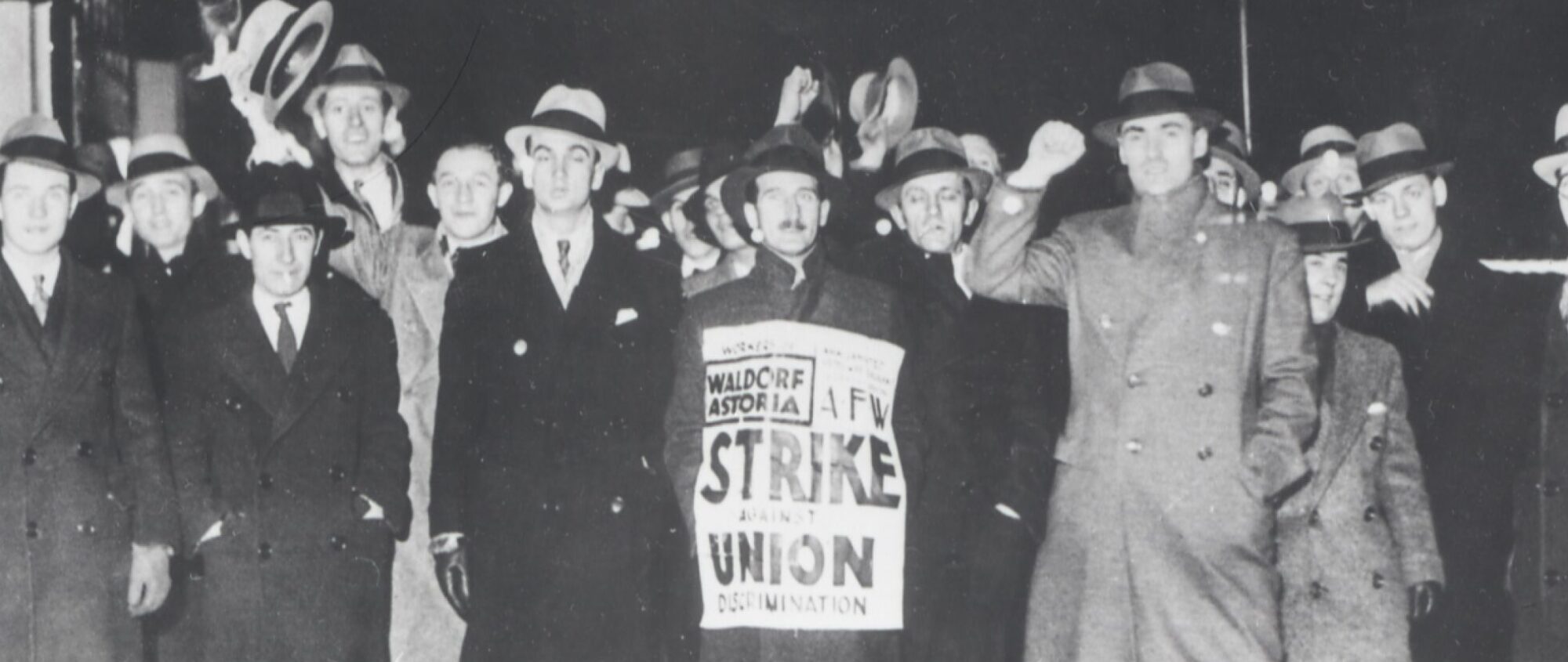
The strike at New York University is entering its second week. Local 2110 of the UAW represents graduate teaching assistants at the university, who organized a union to protest the fact that teaching assistants increasingly handle a huge workload of teaching, preparing coursework and grading papers and exams. The union won recognition from the university and a contract in 2002. It was the first of its kind, as the Clinton-appointed National Labor Relations Board had only recently ruled that graduate teaching fellows are “workers” under the law, entitled to protections under the law as a union.

As swiftly as those new rights were granted by the Clinton Board, they were taken away by the Bush Board, who ruled that teaching fellows are not “workers,” do not have a right to form a union and are not entitled to protection under the law from retaliation and discrimination. NYU, always looking to make and save money, simply decided to ignore its staff union and rebuff efforts to negotiate a successor contract.

Now, without a contract, and with no rights under the law, the graduate teaching fellows at NYU are on strike. They are asking tenured faculty to issue statements in support of the union, and to hold their classes off campus. They are asking students, parents, alumni and the public to call on NYU President John Sexton to recognize and negotiate with the union.

The union has daily noontime rallies and roving picket lines. I saw a very energetic picket line outside the Bobst library this evening. Just head to Washington Square Park, follow the noise and join in.

Why Tuesday?

Tuesday, November 8th, 2005

Like a good citizen, I voted today. “Yes” on 1 and 2, “No” on 3 and 4, against Whitey for Mayor, Socialist Workers where I could, Working Families where I could not and write-in votes for “Socialism” for the judges and Public Advocate.

One question: why the Hell are we voting on a Tuesday?

Breaking Up With Work Is Hard To Do

Saturday, November 5th, 2005

It’s funny how quitting a job can sometimes feel like breaking up with a girlfriend. Even if the break-up occurred for good reasons, it tears you up to hear what she’s been up to, and makes you wish, if only for a moment, that you were still there.

Sunday’s New York Times profiles the upcoming contract fight for the city’s hotel employees union, where I worked for three years before resigning last November 3rd. That fight was brewing for at least as long as I worked for the union, so I’ve had a front row seat to this drama.

The term “Me Too” still makes my heart sing. More than just a promise to keep the employees working, as the Times frames it, a “Me Too” is actually where the company signs the contract before it is even written. Whatever the other companies agree to, we do too. Please don’t strike us. It’s key. A general hotel strike does no real damage if it hurts all the industry’s competitors equally. But if the hold-outs are shuttered while their competitors who made peace with the union do boffo business, that’ll nudge the bosses to settle a lot sooner. Besides, no matter how impressive a $30 million war chest may be (and the membership referendum that voted by a nine to one margin to tax themselves ten dollars a week for two years is one of the most impressive, and unsung, victories for working people last year), it won’t last long with all 27,000 members out on picket lines.

Next year’s nine city hotel strike will likely be a historically epic battle between trade unions and the multinational corporations. My guess is that it will be the first real test of the Change to Win federation. This will be where talk is translated into action. It’s going to be a tough fight. I’m sorry that I won’t be a more active participant. But you can’t go home again. But I will be there on picket lines, if and when they materialize, and I will be exhorting you, dear readers, to do the same.

This seems as good a time as any to announce that I have finally accepted a permanent position with a union (well, as permanent as any job in the labor movement can be). I started this blarg when I was unemployed. I’m still figuring out how much I should talk about work. So, all I’ll say now is that I’m organizing, somewhere in the teacher’s union. Fight the good fight, comrades.

Radio City Lock Out

Thursday, November 3rd, 2005

For the benefit of readers who lack a Masters degree education in Labor Law, or a brain in their skulls, when workers return to their job site with no conditions or stipulations after a walk-out, and their boss responds, “No, I will not allow you to return to work,” that is not a strike. That’s called a lock-out, and it’s what management has done to the union musicians at the Radio City “Christmas Spectacular.”

Throughout contract negotiations with Local 802 of the Musicians union, Cablevision, the managers of the Radio City Christmas Show have made outrageous and provocative demands. Although the union and Cablevision are agreed on all financial matters in the contract negotiations, management will not let the union return until…well, it’s not really clear why they won’t sign the contract and let the musicians return.

“We have told the musicians in no uncertain terms that until there is an agreement and there is no possibility of them walking out on future performances, they remain on strike and cannot return to the Music Hall,” doth decreed the pinheads at Cablevision. Again, it’s a minor point, but I am a stickler for such things, it’s only a strike if the union decides not to work. If the union workers unconditionally offer to work, and the boss refuses to let them, it’s a lock out.

Call the Radio City box office at 212-307-1000 and tell them to bring live music back to the Christmas show. Sign the damn contract.

Besterberg, Where’s the Resterberg?

Wednesday, November 2nd, 2005

What a disappointing decade and a half it’s been for fans of Paul Westerberg. The mercurial former lead singer for the mighty Replacements moved from glossy pop rock to over-produced singer-songwriter navelgazing to under-produced home recording reclusiveness, from major label “next big thing” to indie label “has been,” from sober to drinking again.

Westerberg’s cult status is consecrated, to an extent, by the Rhino collection, “BESTerberg: The Best of Paul Westerberg,” a curious 20 song collection culled from six of his nine albums, plus assorted extras, that feels like a condensed version of what should have been a three record set. B-sides and soundtrack contributions, like his anemic cover of “Nowhere Man” and the AIDS-themed rocker “Stain Yer Blood” (finally available without the “witty banter” from the tv show “Friends”) properly belong on a fuller collection of odds and sods (call it “RESTerberg”), along with some good stuff that didn’t make the cut, like his covers of “Make Your Own Kind of Music” and “Sunshine,” as well as the Danish bonus track, “33rd of July.” Ponderous clunkers like “A Star is Bored” and “Man Without Ties,” however, are more properly classified as “WORSTerberg.”

What’s good on here are mostly some mid-tempo ballads filled with regret and ennui, like “Things” and “Once Around the Weekend” (presented here in a too-busy alternate mix). The wistful “Love Untold” manages to overcome not only a slightly saccharine flavor, but makes a line about wearing clean underwear “just in case” sound charming and romantic. “It’s a Wonderful Lie” sounds like the sadly resigned flip side to the old Mats’ song, “Talent Show,” while “Lookin’ Out Forever” still sounds ragged and desperate, if a bit too much like Tom Petty.

Paul Westerberg stands now on the precipice of the peculiar variety of following his own muse that Alex Chilton rode to artistic oblivion. The next 15 years could be fascinating, or they could be a ridiculous train wreck.

Wal-Mart Video: The High Cost of Low Price

Tuesday, November 1st, 2005

Join the Socialist Party of New York City on Sunday, November 13 at 3:00 pm for a screening of the new documentary, “Wal-Mart: The High Cost of Low Price.” Stick around for a discussion of anti-Wal-Mart activism in NYC.

Location: 339 Lafayette Street, 3rd Floor, NYC 10012
Directions: Take the B, D, F or V to Broadway/Lafayette, or the #6 to Bleecker.

Election Day Voting Advice from the Socialist Party

Tuesday, November 1st, 2005

The Socialist Party of New York City has endorsed only one candidate in the 2005 citywide elections: Gloria Mattera for Brooklyn Borough President. Gloria is a seasoned community activist with whom we have worked and who has secured our trust. Her Green Party campaign is a historic challenge to Democratic machine politics in Brooklyn, enlisting the support of hundreds of activists, raising tens of thousands of dollars (and potentially qualifying for matching funds). She not only deserves your vote in November, she deserves a campaign donation from you now.

There are four ballot questions on the November general election ballot. The first items questions are statewide questions. The Socialist Party of New York State recommends that you


VOTE “YES” ON QUESTION 1

It’s hard to get excited about this question State budgets in New York are essentially drafted and approved by three men: the governor, the speaker of the assembly and the leader of the senate. This constitutional amendment would give two of those men, representing the state legislature, more power to draft and amend the budget. Plus, in a stroke of brilliance, this ballot question aims to redress the perennial problem of late state budgets by simply making the fiscal year begin a month later!

Nevertheless, the shift in power from the state executive to the state legislature is a timid step forward for bourgeois democracy, and the creation of an Independent Budget Office and other safeguards may one day translate into slightly less patronage and graft. You might as well vote “yes” if you’re already standing in the voting booth.


VOTE “YES” ON QUESTION 2

This item would authorize the state to borrow $1.45 billion investment in transportation infrastructure. Half would go to the state Department of Transportation for spending on roads and highways, and half to the Metropolitan Transportation Authority for spending on railroads and mass transit.

The MTA has a maddening tendency to obscure its budget process. Commuters who are upset by repeated subway, Metro North and LIRR fare increases might be tempted to vote “no” out of spite. Furthermore, the lack of clear priorities means that projects that are closer to the hearts of voters (such as our-long delayed Second Avenue subway) could be pushed aside for business-favored boondoggles like the rail connection from JFK airport to Wall Street that Governor Pataki favors.

In principle, the Socialist Party detests these kinds of bond acts because it places the financial burden – an already cumbersome state debt load – on the shoulders of the working class rather than taking it from the hides of the rich. Nevertheless, the MTA needs massive amounts of new money now. We still call for higher taxes on the wealthy and their cars and gas, as well as higher tolls on our bridges and roads to provide more money for mass transit. This bond act doesn’t preclude more radical matters. It simply pumps more money into the system now.

Voters have already rejected a similar bond act five years ago. We urge you to cross your fingers, hold your nose and vote “yes.” The MTA clearly needs the money. In fact, they kinda already have this borrowed money budgeted in, so if the question fails, you can count on your subway fare increasing and you can probably kiss that Second Avenue subway goodbye for another two decades.

Questions Three and Four are proposed by the City Charter Revision Commission. The Socialist Party of New York City urges you to


VOTE “NO” ON QUESTION 3

This item would amend the city charter to charge the Mayor with establishing a code of ethics for administrative hearing officers. A casual reader of this ballot question would assume that it is in response to the Brooklyn judges scandal and support the measure. It is not. This measure does not deal with judges; it deals with judge-like officers that adjudicate parking tickets, noise complaints and other trivial non-criminal matters.

This ballot measure is superfluous. There is nothing stopping the New York City Council from crafting a code of ethics for these administrative hearing officers. The Mayor is using this item, and the City Charter Revision process, to cynically manipulate other questions (such as one mandating smaller class sizes in public schools) off the ballot. It was a tactic that Mayor Giuliani regularly used, and his Republican successor has learned it well. Send him a message that voters won’t stand for it any more. Shoot this one down.


VOTE “NO” ON QUESTION 4

This item is a blast from the past. During the fiscal crisis in the 1970′s, New York City’s budget was put under strict control of various super-governmental agencies and committees. The last vestiges of this undemocratic control will expire in 2008, when New York State’s Financial Control Board will lose its veto power over our city budgets. This ballot question would codify the austerity budgets that were imposed on us from afar into our own City Charter.

Many of today’s voters probably don’t remember the days when the headlines blared “Ford to City: Drop Dead,” so it might be hard to fathom the expansive government program of affordable transit and housing, free college, publicly-funded art and generous civil service benefits that we had and how it was all stripped away from us by a “crisis” that was manufactured by bankers and right-wing politicians who wanted to make an example of New York City. We are finally set to regain our independence and reclaim our exceptionalism. It’s time for a new headline: “City Voters to Charter Commission: Drop Dead.”